✅ Updated: April 2025 — Tailored for climates, cities, and lifestyles. No jargon. Just mastery.
Let’s be honest — most men walk into a tailor or store and pick suit fabric based on:
→ What’s shiny
→ What’s cheap
→ What the salesman pushes
Big mistake.
Your suit fabric is the foundation of your look, comfort, and confidence. Get it wrong — and no amount of tailoring can save you.
This guide doesn’t just teach you how to buy fabric — it teaches you how to think like a tailor. From fiber to weave, weight to climate — you’ll learn everything the showrooms won’t tell you.
Buy smart. Look sharp. Dress for your life — not the mannequin.
🧵 Why Fabric Quality Matters More Than You Think
The fit and cut of a suit is vital — but if the fabric is cheap or wrong for the occasion, even the sharpest tailoring cannot save it.
- Cheap fabrics: Make even expensive tailoring look ordinary.
- Great fabrics: Add drape, sheen, and natural movement that immediately signal quality and status.
- Feel and touch: At the end of the day, the true quality of fabric is judged best by hand and by wearing.
As we believe at TailorWear: fabric is the soul of tailored clothing.
👔 What You’ll Learn in This 2025 Masterclass
- 🧵 The #1 rule of suit fabric purchase (it’s not thread count!)
- 🐑 Wool, Linen, Cotton, Blends — which one suits YOUR climate & lifestyle
- 📏 Fabric weight guide: 220g vs 380g
- 🔍 Weaves decoded: Twill, Herringbone, Birdseye — when to wear each
- 🚫 7 deadly fabric mistakes (even stylish guys make #3)
- ✅ Free printable: “Suit Fabric Selector Checklist 2025”
🧥 The Golden Rule of Suit Fabric (Fit > Fiber > Fashion)
“A ₹25000 suit in perfect-fit wool-blends beats a ₹50,000 off-the-rack mess in ‘premium’ cashmere.”
Repeat after us:
→ Fit is king — even the finest fabric looks bad if it doesn’t fit
→ Fiber is queen — choose based on climate, occasion, lifestyle
→ Fashion is the court jester — trends fade, quality remains
Never reverse the order. Never.
✅ Wool — The All-Rounder Champion
Wool is the most popular choice for suits because it’s durable, breathable, and holds its shape well.
→ Why it works: Naturally temperature-regulating, resists wrinkles, drapes beautifully, comfortable year‑round and works across climates.
→ Best for: Offices, weddings, year-round wear (except peak summer in North India)
→ What to look for:
→ “Merino” or “Virgin Wool” — softer, less itchy
→ “Worsted Wool” — smoother, sleeker finish — ideal for formal suits
💬 TailorWear Tip: If you travel a lot, choose “high-twist wool”. It resists wrinkles and breathes better.
➤ Understanding Super Numbers (Super 100s, 120s, etc.)
Wool fabrics are often labeled Super 100s, 120s, 150s…
- Higher “Super” → finer fiber, softer and lighter fabric.
- But: very high Supers (160s+) can be too delicate for everyday wear.
- For most professionals → Super 100s–120s strike the right balance between fineness and durability.
📌 So yes, wool is always a safe bet — but choose the type carefully depending on occasion and climate.
✅ Linen — The Summer King (With Wrinkles)
“Linen is perfect for summer but wrinkles easily.”
→ Why it works: Ultra-breathable, lightweight, perfect for heat
→ Best for: Destination weddings, brunches, tropical places
→ The wrinkle truth: Yes, it wrinkles — that’s part of its charm. Don’t fight it — embrace the “lived-in elegance.”
→ Pro hack: .
⚠️ Avoid 100% linen for office wear unless you have a steamer at your desk.
✅ Cotton — The Casual Sophisticate
“Cotton is crisp and casual.”
→ Why it works: Affordable, breathable, easy to care for
→ Best for: Startups, creative offices, daytime events, summer Fridays
→ The catch: Lacks drape, wrinkles fast, fades over time
→ Upgrade move: Choose high-twist cotton (e.g., Fresco) — tighter weave, more structure, less wrinkling
💡 Style Tip: Cotton suits look best in earth tones — beige, olive, light grey — not black or navy.
✅ The Appeal & Problem with Synthetic Fabrics
Your original draft covered this perfectly:
- Polyester and artificial fibers have gained prominence because they are affordable and easier to maintain — they resist wrinkles and shine under store lights, which tempts many buyers.
- But the truth is → polys don’t breathe, they trap heat, and the “shine” looks cheap.
📌 They’re “value for money” only if budget is the sole consideration. For true elegance, stick to wool/blends, not plain polyester.
✅ Blends — The Smart Compromises
“Blends can offer the best of both worlds — but avoid polyester unless absolutely necessary.”
→ Wool-Linen (60/40 or 55/45) → Ideal for Spring/Autumn — breathable but structured
→ Wool-Silk (90/10 or 85/15) → Adds subtle sheen — great for evening events, receptions
→ Wool-Polyester Blends → Only for emergency budgets — traps heat, shines weird, pills fast
→ If you must: Max 30% polyester — never 50/50
📊 Fabric Comparison Table
| Fabric | Pros | Cons | Best For |
|---|---|---|---|
| Wool | Breathable, drapes well, durable | Expensive (but worth it) | Year‑round office, weddings, formals |
| Cotton | Breathable, affordable | Wrinkles & Fades easily | Semi‑formals, summer day suits |
| Linen | Airy, casual elegance | Wrinkles a lot | Warm country weddings, leisure suits |
| Polyester | Cheap, wrinkle resistant | Shiny, traps heat, cheap look | Budget suits only (avoid for luxury) |
| Blends | Balance between cost & comfort | Variable depending on mix ratio | Daily wear suits (avoid >50% poly) |
📏 Fabric Weight Guide: What Works in Indian Climates
| Weight (grams per meter²) | Climate Suitability | Best For | Avoid In |
|---|---|---|---|
| 220–260g | Peak Summer & Humidity (Mumbai, Singapore) | Lightweight wool, Linen | Winters, Cold Climates |
| 280–320g | Spring/Autumn | Lightweight wool, wool-linen blends, fresco cotton | Peak May-June heat |
| 340–380g | Winters, Cold Climates | Flannel, tweed, heavy wool, wool-silk blends | Peak Summer & Humidity (Mumbai, Singapore) |
💬 TailorWear Insight: Most Indian men do best with 280–320g year-round — breathable enough for summer mornings, structured enough for AC offices and winter evenings.
🔍 Weaves Explained: Twill, Herringbone, Birdseye, Plain
“The weave affects how the fabric looks, feels, and performs.”
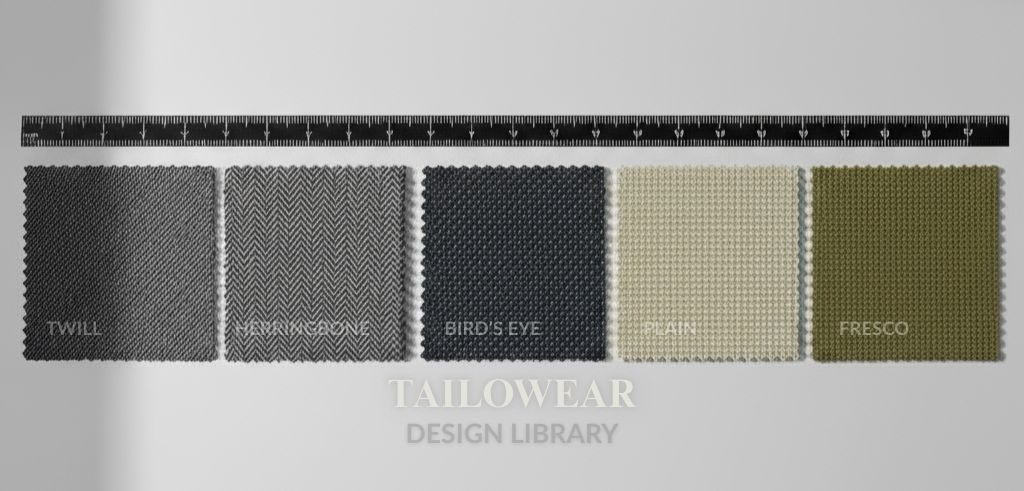
✅ Twill Weave
→ Diagonal rib pattern — like fine corduroy under fingertips
→ Pros: Durable, hides wrinkles, drapes beautifully
→ Best for: Business suits, everyday wear
→ Look for: Subtle sheen, soft handfeel
✅ Herringbone Weave
→ V-shaped zigzag pattern — textured, elegant
→ Pros: Visual interest, hides dirt, great for winter
→ Best for: Winter suits, heritage looks, textured blazers
→ Avoid in: Formal banking/law interviews — too casual
✅ Birdseye Weave
→ Tiny diamond pattern — subtle, professional
→ Pros: Sophisticated, low-key texture, perfect for conservative industries
→ Best for: Banking, law, corporate offices
→ Pair with: Solid shirts, no loud ties
✅ Plain Weave
→ Flat, simple over-under pattern
→ Pros: Crisp, clean, affordable
→ Cons: Wrinkles easily, lacks depth
→ Best for: Cotton shirts, summer suits, casual blazers
🖐️ Pro Move: Run your fingers over the fabric — twill feels ribbed, birdseye feels pebbled, herringbone feels zigzagged.
🚫 7 Deadly Suit Fabric Mistakes (Avoid These!)
Even ONE can ruin your investment, regardless of how much you spent.
- Buying polyester for summer → Instant sweatbox. Looks shiny, smells worse.
- Ignoring climate → Heavy flannel in Mumbai? Light linen in New York winter? Big no.
- Choosing wrong weight → 380g wool in Singapore humidity = torture.
- Falling for “Super 200s” gimmicks → Too delicate for regular usage — pills in 3 wears.
- Buying from an untrusted source → Build a relationship with your supplier or touch the fabric.
- Mismatching formality → Chequered weave at bank interview? Too casual.
- Forgetting maintenance → Wool needs brushing. Linen needs steaming. Cotton needs ironing.
💡 TailorWear Tip: Experience Matters
“Buying quality fabric is an art that can’t just be taught; it comes from experience of touch and time.”
No article, video, or blog can truly substitute the experience of handling fabrics. That’s why at TailorWear, we guide clients personally with information, swatches and touch.
Choosing fabric is half the suit. The other half is tailoring = together they make the gentleman.
👉 [Order Fabric Swatch Kit – No Guesswork]
👉 [Explore Custom Suit Collection – Perfect Fit Guaranteed]
✅ Final Checklist: Suit Fabric Selector 2025
☐ Know your climate (Mumbai heat? Delhi winter?)
☐ Choose fiber: Wool (year-round), Linen (summer), Cotton (casual)
☐ Pick weight: 280–320g for most Indians
☐ Select weave: Twill (versatile), Birdseye (formal), Herringbone (textured)
☐ Avoid polyester (unless <20% blend)
☐ Order swatches before buying
☐ Test: Crumple, Sheen, Drape, Feel
🖨️ Download Printable PDF: [Coming Soon — “Suit Fabric Selector Checklist 2025”]
(Create later as lead magnet — collect emails in exchange!)
❓ FAQs: Suit Fabric for Indian Men
Q: What is the best suit fabric for summer?
A: Wool (tropical weight Super 100–120s) → versatile, breathable, lasts long. Linen for hot summers/beach weddings. Avoid 100% linen for the office – too wrinkly.
Q: Is Super 150s wool good for daily wear in India?
A: Yes, if you’re gentle with it. Avoid Super 180s+. It’s too delicate for Indian commutes and humidity.
Q2: What fabric do top fashion brands use for their off-the-shelf suits?
A: Most use polyester-viscose and its variants for the largest part of their collection. You should check the garment labels before buying.
Q: Can I wear cotton suits to the office?
A: Yes, in startups, creative fields, or summer Fridays. Avoid in banking/law, opt for wool or birdseye weave. You may want to read the Job Interview Outfit Guide to deep-dive into the type of suits, you should wear to office.
Q: Where can I get fabric swatches in India?
A: TailorWear offers curated swatch kits.
Q: How do I care for wool suits in humidity?
A: Brush after wear, air out overnight, use cedar hangers, avoid plastic covers. Steam — don’t iron.